Ever since I was young, I had been surrounded by books.
Whenever a book was within reach, I read it. It didn’t matter whether it was history, science, philosophy, or literature. If there was a book, I opened it.
Whether it was a blessing or a curse, I was born the eldest son of an influential family that lacked for nothing. Both of my parents had once walked the path of scholars and had even earned doctoral degrees, so they never discouraged my thirst for knowledge.
If anything, they worried that I would become trapped within the closed world of academia.
Because of that, I often slipped away from my hometown on short journeys.
As the only son for many years, I rarely heard the word “no.” Whenever I wanted to do something, my parents usually indulged me.
Eventually, I realized that the world described in books was not the entirety of reality.
Using the privilege of being the beloved eldest son, I began traveling from a young age whenever I could secure permission.
My parents were usually too busy to accompany me, so they always assigned someone to protect me.
Those escorts were far stricter than my parents.
Since their lives—and perhaps the lives of their families—depended on my safety, they only allowed me to visit places that looked as though they had stepped straight out of travel brochures.
Naturally, I was dissatisfied.
Whenever an opportunity arose, I would argue my case before my parents. Like an addict unable to abandon his drug, I repeatedly visited not only new places but also destinations I had already seen countless times.
Even then, my passion for learning never faded.
I entered the most prestigious educational institution in the region, maintained outstanding grades, and grew into the sort of son who never caused his parents any concern.
My mother was often even busier than I was.
Whenever something happened that deserved celebration, my father would always be the first to arrive, pulling me into a tight embrace while proudly congratulating me.
Compared to the achievements of my father—the once-in-a-century genius everyone admired—my accomplishments seemed modest.
Yet growing up while watching him genuinely rejoice over every success gave me unwavering confidence.
I became an adult convinced that failure would never find me.
That I could accomplish anything.
And the result of that confidence was the person standing here now.
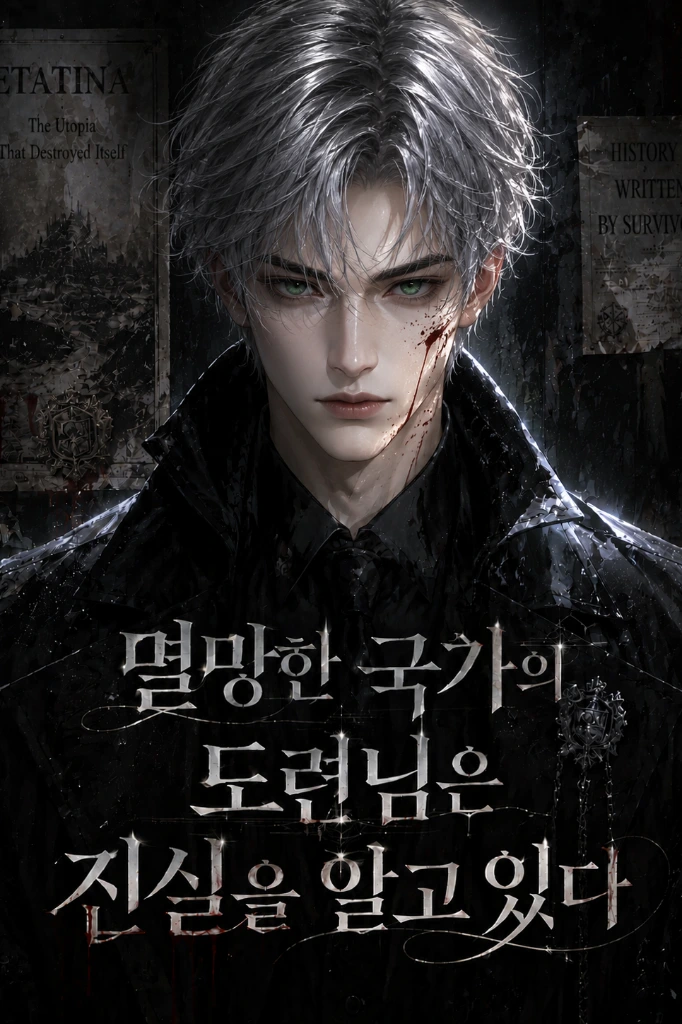
In front of an antique bookstore at the foot of Etatina Hill.
I pushed open the wooden lattice door.
The glass-paneled door felt as heavy as waterlogged cotton, swollen from years of humidity. It creaked loudly before finally shutting behind me.
Surprisingly, it blocked sound completely.
The rain outside vanished the moment the door closed.
A rusty wind chime hanging above the entrance rang softly.
At the sound, an elderly man emerged from deeper inside the store.
He removed his round spectacles and slowly approached.
Judging by the book in his hand, he had apparently been reading while waiting for customers who never came.
“You came from the hill.”
The old man identified where I had come from with a single glance.
He slipped his glasses into his shirt pocket and placed the book beside the register.
“Yes. That’s right. I came from Humanita. I’ve been staying in Etatina for a while.”
“I see. Are you a researcher?”
“No. I run a small business in Humanita. Reading books from various fields is just a hobby of mine. I thought I’d take a look around. What time do you close?”
“Don’t worry about that. Take your time.”
His expression remained neutral.
“After all, this is merely a bookstore an old man opened for fun.”
Without another word, he picked up his book and disappeared into the back.
There wasn’t even the gentle smile I had become accustomed to seeing in Etatina.
Whether he trusted me completely or simply believed none of the books were worth stealing, he seemed almost absurdly unconcerned about leaving the shop unattended.
Still, since I had effectively been granted unlimited time to browse, I accepted his generosity and began examining the countless books packed from floor to ceiling.
Naturally, I gravitated toward the history section.
Although both of my parents were medical doctors, I had always been far more interested in the rise and fall of civilizations than in saving lives.
I still remembered spending long nights reading books alongside them, discussing history until my curiosity was finally satisfied.
Most of the books concerned the history of the Bloodon Empire and the Kingdom of Etatina.
The Bloodon Empire was enormous, so information about it was plentiful.
Etatina was different.
The amount of material available was surprisingly limited.
Given that Etatina was smaller than many cities within the Empire, the shortage wasn’t entirely unreasonable.
Yet when I compared it to Humanita—a nation of comparable size, yet overflowing with records—the discrepancy felt strange.
Only three explanations came to mind.
Research had never been conducted properly.
Records had been poorly preserved.
Or access to information had been deliberately restricted.
The few surviving records painted a remarkably consistent picture.
According to them, Etatina had been the most backward nation in existence.
Its people supposedly possessed less intelligence than children of the Bloodon Empire.
Their manners were said to be worse than those of animals.
Illiteracy was allegedly so widespread that they communicated using pictures.
Traffic laws barely existed.
Their standard of living was lower than that of ancient societies.
No matter which source I examined, every account said the same thing.
As though someone had coordinated the narrative beforehand.
Yet despite being praised throughout my academic life for my intelligence, I had always found those descriptions suspicious.
Whenever I questioned my father about them, he merely repeated the same explanations found in the books.
And that only deepened my curiosity.
A history book of Etatina.
Inside a bookstore in Etatina.
Perhaps this would finally answer my questions.
I selected a volume from the Domestic History shelf.
It was a textbook compiled from lectures intended for younger students.
After checking the table of contents, I opened to a chapter that caught my eye.
And began reading.
“Even so, the researchers at Etatina University never gave up.”
“They believed robots could improve people’s daily lives.”
“Many of you are already using the robots they developed.”
“You all have one at home, don’t you?”
“Some are shaped like dogs. Others resemble humans.”
“Anyone with a dog robot, raise your hand.”
“…Robots?”
I blinked.
“Etatina had robot technology?”
According to the text, over half of all children owned dog-shaped robots.
Every single household possessed human-shaped ones.
The dog robots were indistinguishable from living animals in touch and behavior.
The human robots could handle everyday tasks depending on their training—shopping, cleaning, and other household duties.
Even their appearance and skin texture were identical to those of real humans.
I kept reading.
“Your grandparents needed identification cards whenever they visited hospitals.”
“You don’t.”
“Now all you need is your eyes or wrist.”
“The system automatically recognizes your iris and veins.”
“Beginning next year, you’ll be able to use the same technology in ordinary stores.”
“The day may soon come when telephones become unnecessary.”
“Perhaps you’ll speak to your parents and friends through brainwaves, just like in science fiction.”
“How…?”
I stared at the page.
“How could Etatina accomplish something even the Bloodon Empire hasn’t?”
If this account was true, then Etatina had been on the verge of achieving direct brainwave communication.
That possibility stood in complete contradiction to the Etatina I had witnessed upon arriving.
A nation where even my watch couldn’t connect to a map.
A nation seemingly frozen in stagnation.
Yet according to this book, it had once been more technologically advanced than the greatest empire on earth.
Page after page overturned everything I knew.
Nothing matched my education.
Nothing matched my father’s explanations.
Nothing matched accepted history.
“…Was everything I researched a lie?”
My throat tightened.
“In the best environment imaginable… I was supposed to produce the best results.”
My legs gave out.
Sliding down the bookshelf, I collapsed onto the floor.
Cold sweat soaked my palms.
The book cover stuck to my skin.
“No…”
My voice trembled.
“Etatina couldn’t possibly have developed this far…”
It couldn’t.
As a conquered nation of the Empire, it should have remained backward.
Inferior.
Dependent.
That was what I had always believed.
The hand holding the book shook violently.
My heart pounded.
The monster called curiosity that had lived inside me since childhood rampaged through my mind.
Like a starving beast discovering a feast.
Everything I knew was being torn apart.
Knowledge carefully accumulated over a lifetime was ripped from its shelves and scattered.
Facts burned.
Assumptions shattered.
The framework of common sense I had spent decades constructing collapsed like a house of cards.
What exactly had Etatina been?
What had I spent all those years studying?
If this book was telling the truth, then the academic achievements I had earned through my intelligence were built on a false foundation.
A degree earned through ignorance.
A scholar who understood nothing.
The realization left me dizzy.
And yet…
I couldn’t stop reading.
The further I went, the more impossible the contents became.
Etatina had once controlled weather.
Predicted disasters.
Prevented casualties.
Maintained stable temperatures year-round.
A civilization rivaling the Bloodon Empire itself.
But the Etatina outside these pages was dark.
Rain-soaked.
Sunless.
Artificial.
The breeze itself seemed to come from giant machines hidden somewhere beyond sight.
Even the wind sounded mechanical.
The more I read, the stronger the goosebumps became.
Excitement and terror coexisted within me.
I wanted to know more.
But I was afraid of what I might learn.
By now, I was convinced of one thing.
Etatina had not simply been forgotten.
It had been hidden.
Deliberately.
If even my father’s family—a lineage that had produced generations of brilliant scholars—possessed only distorted records, then someone had gone to extraordinary lengths to erase the truth.
But why?
Why conceal the history of a small vassal state?
I lost all sense of time.
The bookstore disappeared.
The world disappeared.
Only the book remained.
I devoured every sentence.
Questioned every paragraph.
Celebrated every answer.
The excitement reminded me of the days when I would argue with my father late into the night.
Back then, every new discovery felt magical.
But eventually I had exhausted the knowledge available to me.
Nothing surprised me anymore.
Nothing stimulated me.
Not even my parents could satisfy my hunger for answers.
Coming to Etatina had been my final gamble.
And now, as the pages turned faster and faster beneath my fingers, I knew it had been the right choice.
This bookstore would change my life.
I could feel it.
By the time I finished the final chapter, I was grinning like a madman.
Anyone watching would have mistaken me for someone possessed.
My black eyes gleamed with obsession.
The smile twitching across my face looked less like joy and more like insanity.
Yet I couldn’t help it.
I had found something truly new.
Something extraordinary.
Slowly, I closed the book.
Then another question arose.
If Etatina’s future had once been so bright…
How had it become a ruin?
I selected a newer volume.
Its title was simple.
History of Etatina.
I opened the section describing the nation’s downfall.
And froze.
The text had been censored.
Names erased.
Numbers blacked out.
Entire passages deliberately removed.
Only fragments remained.
Yet even those fragments revealed enough.
Etatina had not fallen naturally.
It had been destroyed.
A treaty had been broken.
An invasion launched.
Civilians massacred.
Officials executed.
Soldiers slaughtered.
A nation erased.
But the identity of the aggressor had been meticulously removed from every record.
I checked other books.
The same pattern appeared everywhere.
The glorious chapters remained untouched.
Only the sections concerning Etatina’s destruction had been censored.
Someone was hiding the truth.
Etatina had once been attacked by a force it could not resist.
Its scholars died first.
Its politicians followed.
Ordinary citizens were massacred into silence.
Afterward came occupation.
Control.
Surveillance.
And a long, slow decline.
That much was obvious.
But whether the enemy had come from within or beyond Etatina’s borders remained impossible to determine.
Closing the book, I leaned back against the shelf.
I had always been the type who could grasp the overall picture after reading only a handful of books.
Yet this time was different.
No matter how much information I gathered, something fundamental was missing.
A vital piece.
A single missing screw preventing the entire machine from fitting together.
And for the first time in my life—
I felt as though I was standing before a mystery far larger than myself.